

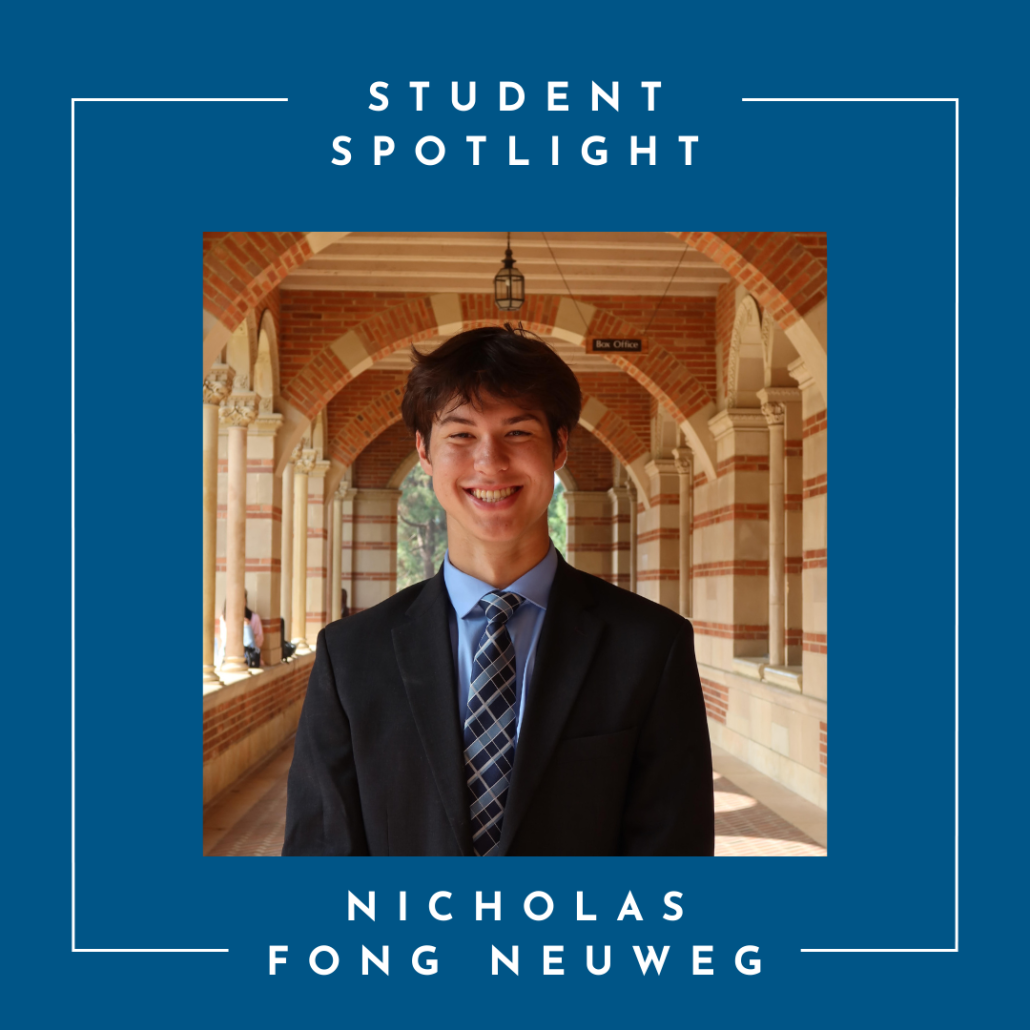
Student Spotlight – Nicholas Fong Neuweg
Meet UCLA undergraduate researcher Nicholas Fong Neuweg!
Nicholas is majoring in Philosophy and is part of the UCLA/Keck Humanistic Inquiry Research Awards program. His project is “Manufacturing Testimony in a Climate of Fear: Epistemic Injustice, Institutional Power, and the Collapse of Truth in the Kern County Child Abuse Trials.”
How did you first get interested in your research project?
I first became interested in this project when I was interning at the Los Angeles District Attorney’s Office in the Conviction Integrity Unit. The purpose of this unit is to reevaluate past inmates’ convictions and determine if all of the information was properly searched for. As an intern, I read through letters pertaining to inmates to see if they had garnered any legitimate information that might change the outcome of their cases. Having seen thousands of stories, I have seen how the justice system which we rely on can often be faulty, having people slip through the cracks of proper justice. I wanted to identify what caused a great deal of people to be falsely accused and so I focused onto a particular instance. This led me to discovering the Kern County Trials and then my research project.
What has been the most exciting aspect of your research so far?
The most exciting part has been watching a philosophical concept become a concrete investigative tool while I map the Kern County record. When I trace one “fact” backward, I can often see its earliest form start as uncertainty, then tighten through repetition and institutional framing. That transformation gives me a way to show epistemic harm without relying on broad claims, because the language changes sit directly in the sources. It also lets the project reveal structure, not just outcome, since I can pinpoint where credibility gets assigned and where doubt gets overwritten.
What has surprised you about your research or the research process?
I expected the biggest failures to look like blatant misconduct, yet the more unsettling pattern involves routine practices that quietly manufacture certainty—leading questions, repeated interviews, and cleaned-up summaries. I also did not expect how much discipline the process demands, since I have to resist premature conclusions long enough to separate what happened from how later accounts retell it. In other words, the work has taught me that “accuracy” often depends less on one dramatic error and more on how small procedural choices accumulate over time. The research process keeps reminding me that the record does not merely document truth; it can also produce a version of truth that later decision-makers treat as self-evident.
What is one piece of advice you have for other UCLA students thinking about doing research?
As someone who had never done any formal academic research and was at first hesitant on doing so, UCLA gave the opportunity for me to not only learn how to do research through mentorship, but also a welcoming community of other people who are passionate about research. Research is often thought about primarily in the scientific field, but there are so many other fields that could be discovered.
What effect do you hope your research has in your field, at UCLA, in your community, or in the world?
I aspire for my research to have an impact on the way the justice system and people who are processed in said system operates. I would want people to take away from my research that no system we have currently is perfect, and it is our responsibility to always be advocates for a most just process.