

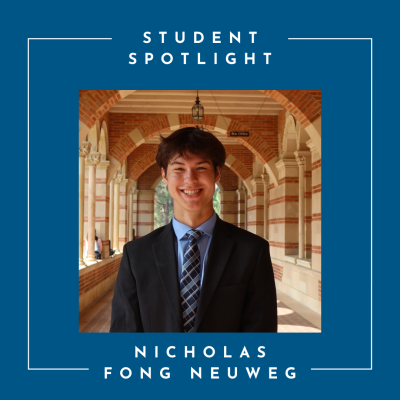
Young man in a dark suit, smiling, under the Royce Hall arches

Student Spotlight – Nicholas Fong Neuweg
Meet UCLA undergraduate researcher Nicholas Fong Neuweg!

Nicholas is majoring in Philosophy and is part of the UCLA/Keck Humanistic Inquiry Research Awards program. His project is “Manufacturing Testimony in a Climate of Fear: Epistemic Injustice, Institutional Power, and the Collapse of Truth in the Kern County Child Abuse Trials.”

How did you first get interested in your research project?

I first became interested in this project when I was interning at the Los Angeles District Attorney’s Office in the Conviction Integrity Unit. The purpose of this unit is to reevaluate past inmates’ convictions and determine if all of the information was properly searched for. As an intern, I read through letters pertaining to inmates to see if they had garnered any legitimate information that might change the outcome of their cases. Having seen thousands of stories, I have seen how the justice system which we rely on can often be faulty, having people slip through the cracks of proper justice. I wanted to identify what caused a great deal of people to be falsely accused and so I focused onto a particular instance. This led me to discovering the Kern County Trials and then my research project.

What has been the most exciting aspect of your research so far?

The most exciting part has been watching a philosophical concept become a concrete investigative tool while I map the Kern County record. When I trace one “fact” backward, I can often see its earliest form start as uncertainty, then tighten through repetition and institutional framing. That transformation gives me a way to show epistemic harm without relying on broad claims, because the language changes sit directly in the sources. It also lets the project reveal structure, not just outcome, since I can pinpoint where credibility gets assigned and where doubt gets overwritten.

What has surprised you about your research or the research process?

I expected the biggest failures to look like blatant misconduct, yet the more unsettling pattern involves routine practices that quietly manufacture certainty—leading questions, repeated interviews, and cleaned-up summaries. I also did not expect how much discipline the process demands, since I have to resist premature conclusions long enough to separate what happened from how later accounts retell it. In other words, the work has taught me that “accuracy” often depends less on one dramatic error and more on how small procedural choices accumulate over time. The research process keeps reminding me that the record does not merely document truth; it can also produce a version of truth that later decision-makers treat as self-evident.

What is one piece of advice you have for other UCLA students thinking about doing research?

As someone who had never done any formal academic research and was at first hesitant on doing so, UCLA gave the opportunity for me to not only learn how to do research through mentorship, but also a welcoming community of other people who are passionate about research. Research is often thought about primarily in the scientific field, but there are so many other fields that could be discovered.

What effect do you hope your research has in your field, at UCLA, in your community, or in the world?

I aspire for my research to have an impact on the way the justice system and people who are processed in said system operates. I would want people to take away from my research that no system we have currently is perfect, and it is our responsibility to always be advocates for a most just process.

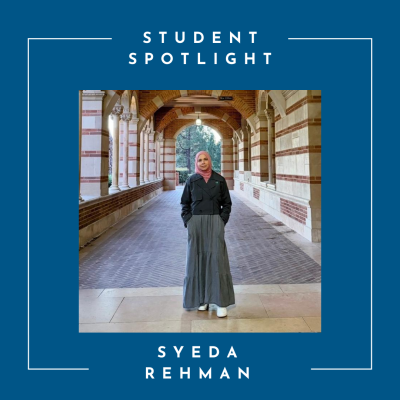
Young woman in hijab and dress stands in the UCLA Royce Hall arches

Student Spotlight – Syeda Rehman

Meet UCLA undergraduate researcher Syeda Rehman!

Syeda is majoring in Sociology with a minor in Labor Studies. She is part of the Undergraduate Research Scholars Program. Syeda’s project is “From Growth to Displacement: Tracking the Impact of SoFi Stadium on Inglewood’s Residents and Small Businesses.”

How did you first get interested in your research project?

I first became interested in my research project through Urban Sociology and Comparative and Historical Methods courses at UCLA. These classes introduced me to process-oriented mechanisms of research, where we look at causal patterns in a case study, rather than a before and after outcome. My research focuses on the city of Inglewood and the development of SoFi Stadium as a case study, examining alliances between private investors, real estate companies and local political actors. It examines how these alliances impact long-term residents and small businesses through soft eviction including rent hikes, deteriorating properties that results in displacement, and whether the promised economic boost of local hires and affordable housing becomes a reality or remains unfulfilled.

What has been the most exciting aspect of your research so far?

The most exciting part of my research was the ethnographic work, where I conducted semi-structured interviews with shop owners and long-term residents, which showed me both perspectives. Some shop owners were in favor of buyout offers for their properties, while long-term tenants described facing displacement through rent hikes or eviction notices and according to them, the promises remained unfulfilled. This taught me the value of subjective experience and how there is no one-size-fits-all or one objective reality in human interaction.

What has surprised you about your research or the research process?

Doing my research, I felt like I was time traveling. Looking through historical documents, I traced Inglewood’s transformation from a white neighborhood to a neighborhood of color after white flight, followed by decades of disinvestment and then eventually becoming a prime case for reinvestment. What surprised me was realizing that this cycle of investment, divestment, and reinvestment is not unique to Inglewood, but reflects the history of many cities.

What is one piece of advice you have for other UCLA students thinking about doing research?

One piece of advice I would give is to not be afraid of trying, even if the result is not what you expect, and to never underestimate your potential. I would encourage students to ask questions and not shy away from asking for guidance when needed. These small steps can boost our intellectual growth as students and novice researchers. I would like to thank my faculty mentors, especially my undergraduate thesis mentor, Professor Berend, for guiding me every step of the way, my graduate student advisor, Greg Kyle, for his continued support, and Dr. Reizman for believing in my research.

What effect do you hope your research has in your field, at UCLA, in your community, or in the world?

I hope my research can show how structural inequalities are built into our systems and how the right policy changes can prevent displacement. If policies based on tenant protection laws, such as rent stabilization, had been implemented earlier, and stronger actions or laws were enforced for affordable housing, displacement rates would have been much lower. By taking small steps toward reform through community centered policies, cities can learn to grow without forcing people out. I hope my case study can help avoid repeating the same patterns in similar divested cities like Inglewood and around the world.