

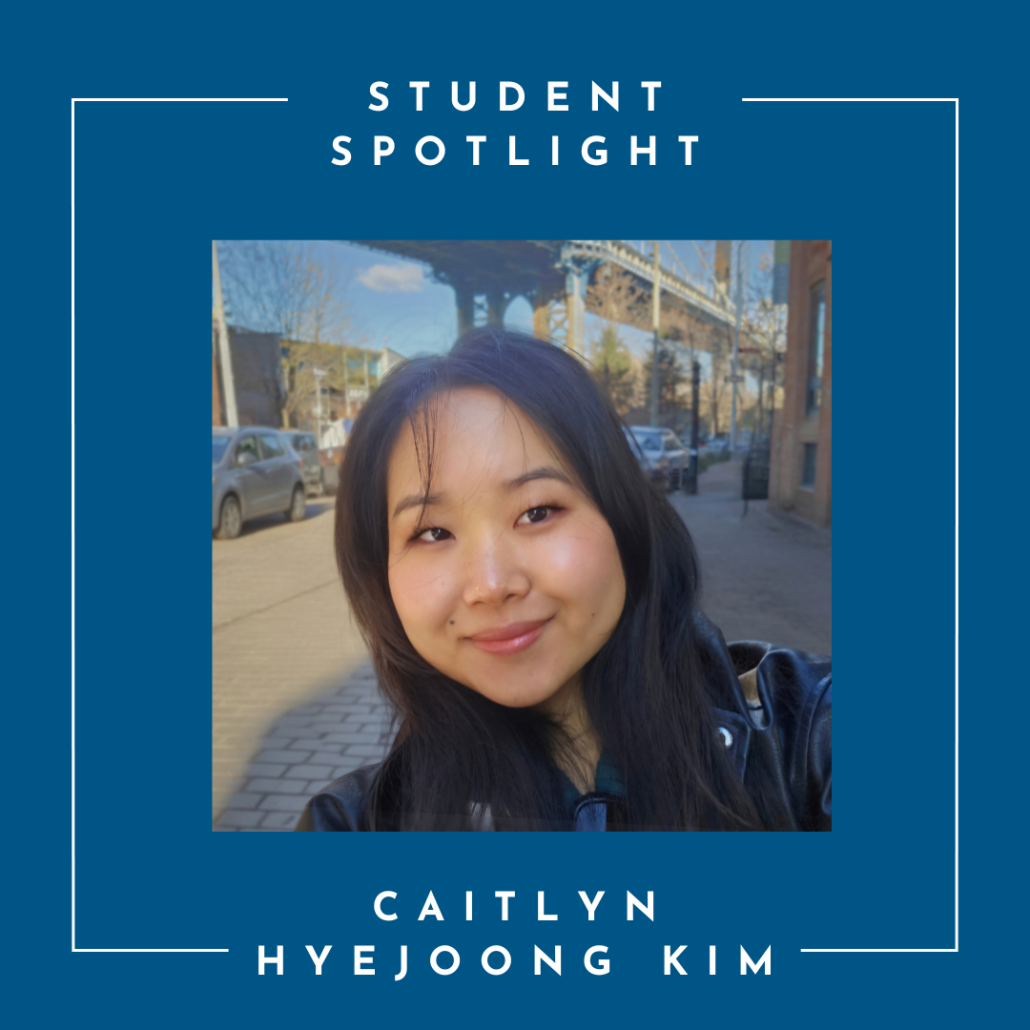
Student Spotlight – Caitlyn Hyejoong Kim
Meet UCLA undergraduate researcher Caitlyn Hyejoong Kim!
Caitlyn is majoring in Sociology and English with a minor in Chinese and is part of the Undergraduate Research Fellows Program. Her project is “Social Life on Los Angeles Public Transportation: Negotiating Space, Civil (In)Attention, and Interaction.”
How did you first get interested in your research project?
I initially began my research journey with an overarching interest in understanding interracial and inter-ethnic relations in diverse urban cities, specifically in Los Angeles. Knowing that I would be taking the Metro and bus to an internship in Downtown Los Angeles during Summer 2025, I decided to attend to the social space of public transportation in Los Angeles, taking advantage of the long hours I would be spending on public transportation to gain some ethnographic experience and observe interactions between strangers. Influenced by popular perceptions of public transit being a space rife with disorder, and having had negative experiences on the LA Metro myself, I anticipated finding interactions and moments of “everyday trouble” between strangers as I began my observations. However, I quickly came to realize that though moments of tension existed, they were also not the prevailing norm of the public transit environment. Instead, I quickly noticed that passengers seemed to primarily keep to themselves while on transit.
Initially, this realization was rather disheartening. After all, I was ultimately interested in exploring how strangers in diverse urban areas interact and negotiate differences. However, taking a closer look at my data opened my eyes to the reality that interactions are indeed a salient feature of the social environment of LA public transit, though the ways in which they played out were drastically different from the more overt verbal interactions I had originally anticipated. By attending to often overlooked, taken-for-granted behavioral details, my data revealed how interactions unfolded in the form of subtle coordination and cooperation. I discovered that on the whole, the social environment of LA public transit is ordinary and relatively “trouble-free,” and found that this “ordinary” state is actively created and maintained by participants through unspoken rules that govern LA public transit, allowing people to take it every day without much incident.
What has been the most exciting aspect of your research so far?
The most exciting aspect of my research has been being able to discover new things about interactions among strangers in public spaces that I had never originally considered. Admittedly, I was initially discouraged that I was not finding what I set out to find in the incipient stages of my research. However, by allowing the data to lead my research inductively, I think I’ve been able to really grow not only as a researcher, but also be more sociologically curious in my day-to-day life. Another really exciting aspect of my research has been being able to see applications of what I learn in the classroom in my own research. Some examples include Erving Goffman’s concept of “civil inattention,” Georg Simmel’s ideas on strangership in the metropolis, Berger and Luckmann’s concept of institutionalization, and William Richard Scott’s three pillars of institutions, to name a few.
What has surprised you about your research or the research process?
I think this has been a theme throughout my research journey, but what’s surprised me is how different my findings have been from what I originally anticipated. It’s really taught me the importance of staying close to my data and finding concepts that fit the patterns and themes that emerge, rather than using my imagination, or developing theory without application. Another thing that has surprised me is how difficult it is to develop a qualitative coding scheme! I’m so thankful for my faculty and grad mentors’ support during this process.
What is one piece of advice you have for other UCLA students thinking about doing research?
First of all, do it! It’s such an amazing experience, and for me personally, it’s truly confirmed that I really love research. Another piece of advice is not to be discouraged if your research goes in a different direction than you originally anticipated. Instead, lean into it, and see what you discover, because at the end of the day, research is about discovering new things, and whatever you find is incredibly valuable.
What effect do you hope your research has in your field, at UCLA, in your community, or in the world?
I hope my research encourages more Angelenos to take public transportation. American public transit in the popular imagination, particularly in Los Angeles, is perceived to be a place of the “other.” This perception isn’t entirely unfounded, as many Angelenos can recall unpleasant encounters or experiences they have had on public transit. At the same time, my findings show that negative experiences on public transit are more often the exception, and that in reality, many people are able to take it regularly without incident. Despite overwhelmingly negative perceptions about the LA public transit system, the experiences of passengers who regularly rely on transit suggest a different reality. For example, according to a 2022 Metro Customer Experience survey, in which 75.5% of respondents reported using Metro at least three days a week, 59.5% were satisfied with their experiences, and 66% said they would recommend Metro. Ultimately, I hope that with increased ridership, the LA public transit system can be expanded and made more accessible, leading to less traffic, less environmental damage, and a more walkable city.