
Posts

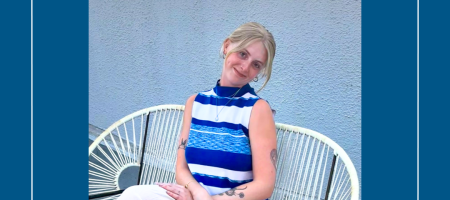
A young blond woman sits on a white wicker bench in front of a gray stucco wall. She is wearing a blue and white sleeveless blouse and and white pants. Her arms are folded in her lap and her hair is loosely pulled back. She is smiling and her head is cocked to the side.

Student Spotlight – Brinn Wallin

Meet UCLA undergraduate researcher Brinn Wallin!

Brinn is majoring in English and is part of the UCLA/Keck Humanistic Inquiry Undergraduate Research Awards program. Brinn’s research project is “The Enduring Phantom of Sylvia Plath: Misrepresentation and a Life Survived by Death.”

How did you first get interested in your research project?

My discovery of and love for Sylvia Plath began at a quintessential time in my life, and one that I view as somewhat of a synchronicity. I first picked up her only novel, The Bell Jar, as I was being discharged from a mental health facility. Though the basis of my hospitalization was different from Plath’s (as well as Esther Greenwood’s in this novel), there were several poignant similarities in our struggles. I started reading her poetry, specifically her earliest poems, which doubled my interest in her. However, I began to notice something while studying Plath and her work in academia: she was known, above all, by her suicide. This repeated focus on her death, more than her immense work and influence, spawned a desire in me to research this misrepresentation of her life, work, and legacy. In doing so, my frustrations deepened as my passion grew. When I transferred to UCLA, I applied to an introductory research program to legitimize what has now been my years-long research journey. This research has made up the most prized and essential part of my years as an undergraduate student.

What has been the most exciting aspect of your research so far?

Everything! If I had to narrow it down to one thing, though, I would say the most exciting aspect of my research is the same thing that overwhelms me: the endless rabbit holes of information, insight, and inquiry that the process of researching yields. I love learning; to me, research is, first and foremost, about learning and fostering personal (and social) growth.

What has surprised you about your research or the research process?

I knew when I first started research what I was getting myself into. Nevertheless, you can never anticipate just how much or how little information you will discover, depending on what specific questions you are asking. At certain points I have found an abundance of scholarly work to support my claims. At others, I could find near to nothing. This is the special part of research, however: the opportunity to build off of the work of previous researchers, while also discovering one’s own unique place within a particular area of scholarship.

What is one piece of advice you have for other UCLA students thinking about doing research?

First I would say: do it! But I would follow that by emphasizing the importance of loving what you research. If you take on a project just to say you did it, or because you view it as just another thing you have to do, I don’t think that it is reason enough to sign yourself up. One of my favorite authors and artists, Anaïs Nin, writes that it is passion which lends us moments of wholeness. This, at least to me, is what sits at the core of research: moments, even if brief ones, that fuel our souls.

What effect do you hope your research has in your field, at UCLA, in your community, or in the world?

Given that my project specifically addresses real-time changes that can be made in the discourse surrounding Sylvia Plath, I hope my research widens the academic lens focused on this larger-than-life (and death!) writer and woman. I hope it allows for greater transformation in the ways we view and treat female artists altogether. And I hope my project positively impacts those who know of Plath, have read her work, or simply heard her name once in passing. In other words, I hope the love I have for her becomes contagious.


Tags: Keck, English, Creative Writing, Sylvia Plath, Undergraduate Research, Undergraduate Creativity


Student Spotlight – Emma Horio

Meet UCLA undergraduate researcher Emma Horio!

Emma majors in English and is a recipient of the UCLA/Keck Humanistic Inquiry Research Award. The title of her project is “Tales of Blood and Thunder: Pulp Fiction and Sexuality in the Nineteenth-Century United States.” Horio’s work examines Louisa May Alcott’s sensation fiction, which has led Horio to the Houghton Library, where she will conduct archival research on Alcott’s writings. Her best piece of advice is to take classes with professors who share your research interests and ask for their guidance.

How did you first get interested in your research project?

I took a class with my now-advisor in Fall 2022, which piqued my interest in the topic of sexuality in American literature. I took another class with him in Spring when I was deciding on a thesis topic, and decided that I wanted to do a project that engaged with American literature of the Victorian era. After a few false starts, my advisor pointed me toward Louisa May Alcott, and the rest was history.

What has been the most exciting aspect of your research so far?

I’m working on Alcott’s sensation fiction, which was fairly recently discovered and consequently hasn’t received as much critical attention. I’m flying to Boston in December to visit the Houghton Library and conduct archival research there, where a lot of her letters, manuscripts, and ephemera are housed. I’m really excited for the opportunity to look at these documents and gain a better understanding of her relationships with her publishers and those around her.

What has surprised you about your research or the research process?

It surprised me how easy it is to fall down rabbit holes. I had originally intended to write my thesis on Alcott’s body of sensation fiction as a whole, which was a rookie mistake on my part. There are so many dynamics at play in that massive body of work that narrowing the scope of my project sometimes still seems like a Sisyphean task.

What is one piece of advice you have for other UCLA students thinking about doing research?

Take classes with professors who share your research interests and ask for their guidance. Use the class as an opportunity to show them your skill, potential, and work ethic.

What effect do you hope your research has in your field, at UCLA, in your community, or in the world?

I hope that my research can assist in deepening our understanding of how sexuality was communicated in popular literature during the Victorian era and provide support for the idea that queer people have always existed under many different labels and cultural conceptions.

Student Spotlight – Milagro Jones

Meet UCLA undergraduate researcher Milagro Jones!

Milagro majors in English and is in the Mellon Mays Undergraduate Fellowship. The title of his project is “Defining Drill: Multiple Meanings, Metaphors, and Memes.” Milagro’s work honors the legacy of authors and poets from Dro City and other parts of Chicago by treating their contributions to literature with empathy and respect. His best piece of advice is that research is for everyone and you can find a meaningful way to participate in research as a UCLA student.

How did you first get interested in your research project?

I first got interested in researching Drill Music in the Transfer Summer Program. Students like myself were told by professors like Dr. Huehls and Dr. San Juan to research something that we cared about. Part of the process of finding a topic was “me-search,” or looking within to research me and what I am passionate about. I care a lot about my brothers in the streets, and many of the authors and poets of Drill Music have passed on and will never get the opportunity to attend a University like UCLA. I want to honor the legacy of artists from Dro City and other parts of Chicago by treating their contributions to literature with empathy and respect.

What has been the most exciting aspect of your research so far?

The most exciting part of research has been presenting through opportunities provided by the Mellon Mays Undergraduate Fellowship. My research has evolved since I began, and receiving feedback from those who attended my presentations, including my faculty mentor, has helped me shape the direction in which I want my research to go. When I began researching Drill Music, I strongly felt like I had to keep it in conversation with an Epic from the traditional English Canon such as Beowulf for example. Feedback from my faculty mentor, Dr. Adam Bradley, and others has helped me to realize that classic works of Drill Music can stand on their own as works of literature worthy to be studied.

What has surprised you about your research or the research process?

The major thing that surprised me is the way in which acclimating to a university environment impacts the way in which I relate to the material I am studying. I am from an environment similar to the one in which the subjects of my research describe in the literature they’ve produced. In layman’s terms, I’m from the ghetto, and it feels disorienting to research literature produced in the ghetto from the vantage point of a university. Spending time in the privileged environment of academia has created a distance between me and the literature I am studying that forces me to question how to approach my subject in an ethical and authentic way.

What is one piece of advice you have for other UCLA students thinking about doing research?

I was cautioned that research isn’t for everybody and told that I didn’t have to pursue research if I didn’t want to. I would express to students the opposite. Research is for everybody, and traditionally, students like myself, a formerly incarcerated single father who got his GED in a correctional facility, are not included in the research process as independent scholars. UCLA, the Undergraduate Research Center – Humanities, Arts, and Social Sciences, and the Mellon Mays Undergraduate Fellowship program are doing something radically transformative by providing an opportunity for independent research to students of all backgrounds. Whatever your story and your passion, you can find a meaningful way to express yourself and contribute to the wealth of knowledge as a student here at UCLA.

What effect do you hope your research has in your field, at UCLA, in your community, or in the world?

I hope to continue researching Drill Music through the humanities lens of English Literature. In my field, I hope to contribute to the first Norton Anthology of Gang Literature. At UCLA, I hope that my work will influence others to consider that gang literature is literature and Drill Music, specifically a subgenre of Hip Hop created by gang members who are as talented as any of the celebrated poets of the traditional English Canon. I want to see Pacman and King Louie’s names in the English Reading Room next to Emily Dickinson, William Blake, William Wordsworth, and John Keats. In the community, I want the kids growing up in the housing projects and hoods to know that UCLA is a University for them. I want the world to know that Drill Music started in Dro City.