
Student Spotlight – Rena Yamamoto
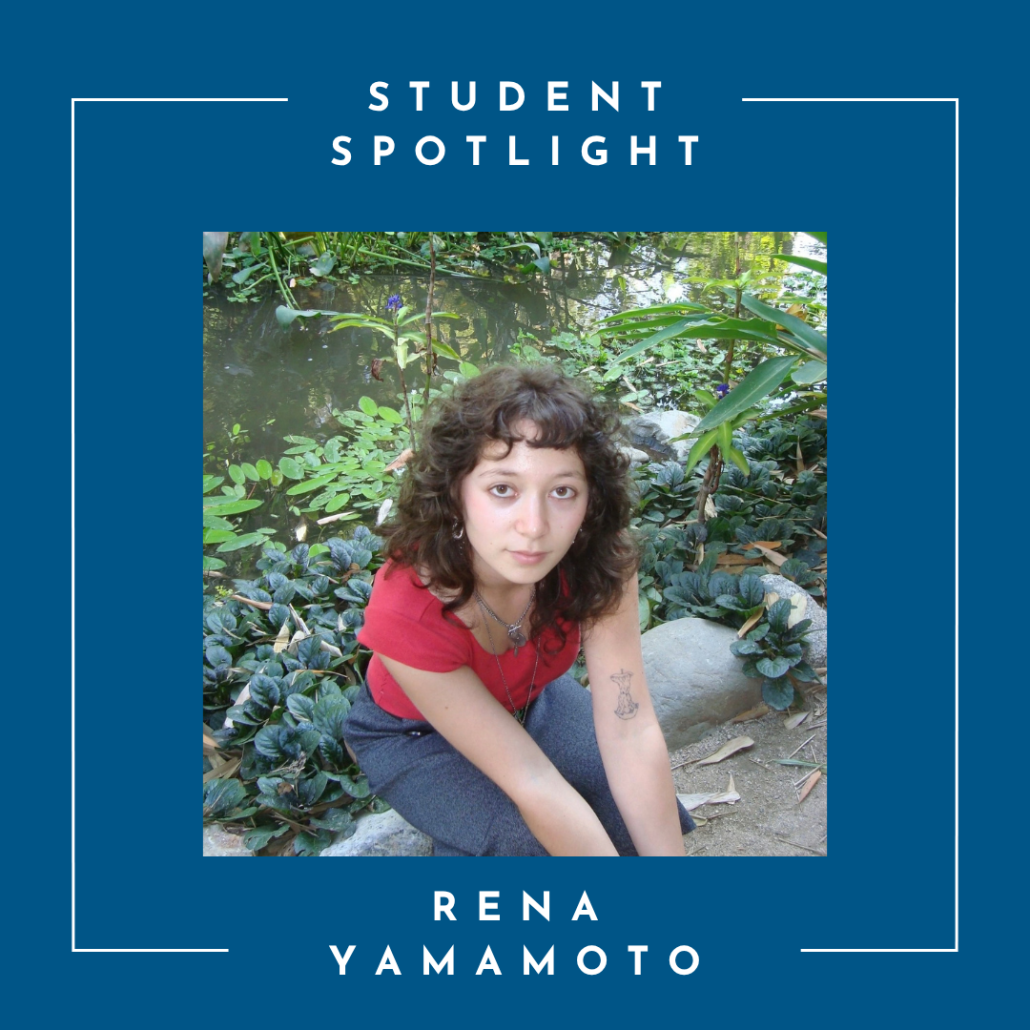
Meet UCLA undergraduate researcher Rena Yamamoto!
Rena is majoring in Art and was a recent researcher in our Summer Fellows Program. Her project was “Come Enjoy the Mission: Examining Old ‘Schools’ and New Crews Tagging San Francisco.”
How did you first get interested in your research project?
I grew up in the Mission District of San Francisco, which has a robust and intersecting history of muralismo, graffiti, and fine art. After coming to UCLA and seeing a lack of graffiti and tagging, I became interested in what produces graffiti culture, and how that interacts with the art world at large. The Mission School, a contested cohort of artists including Ruby Neri, Barry McGee, Chris Johanson, Rigo23, and the late Margaret Kilgallen, is on the surface highly representative of the city, and one of the proudest recent artistic exports of the region. I had heard of them as larger than life figures at the pinnacle of both the graffiti and fine arts scene in the 90s, simultaneous to the dot-com boom and an enormous wave of gentrification. However, I was also curious about how young graffiti artists now, in a post pandemic surveillance state, continue and innovate the legacy of graffiti while the consequences become increasingly severe. The two generations have circumstantial similarities, both taking place at the nexus of technological and surveillance transformations that led the city to crackdown on “visible order” justifying systems of control. I ended up talking to two experts who witnessed the rise of the Mission School, and then focused on speaking with over eight young graffiti artists about their work and experiences.
What has been the most exciting aspect of your research so far?
The trust and honesty of my interviewees! It’s been immensely rewarding to talk to so many young artists and have them be both vulnerable and articulate about the joy and difficulty of continuing this legacy. I also felt more connected to the city as the tags on trashcans, curbs, train tracks, and roof tops became real and relational, revealing a history in plain sight.
What has surprised you about your research or the research process?
The research on the role of graffiti in cities is highly contradictory, with an enormous array of solutions and arguments across the ideological spectrum. I was also surprised to find that some of the most comprehensive quantitative studies were in completely unrelated disciplines, using graffiti in San Francisco as case studies for analysis and prediction.
What is one piece of advice you have for other UCLA students thinking about doing research?
To not be afraid of asking questions, because most people are enthusiastic about their fields and passions and could talk for hours about them! Though it seems daunting to start an independent research project, and often is while doing it, I learned so much about how to be a better student and researcher through it. It has allowed interviews to feel more conversational and informal, which has led me to form genuine connections with my interviewees, and gain insight that they wouldn’t otherwise share.
What effect do you hope your research has in your field, at UCLA, in your community, or in the world?
I hope that this project will allow people to see the value in graffiti beyond broken window rhetoric. Since I focused directly on a few artists that are innovating on Bay Area tagging styles, like busflow, I hope to introduce this style to people who haven’t gotten the opportunity to see it. Look around: there is so much to appreciate about your city in the graffiti and tags—or lack thereof!