

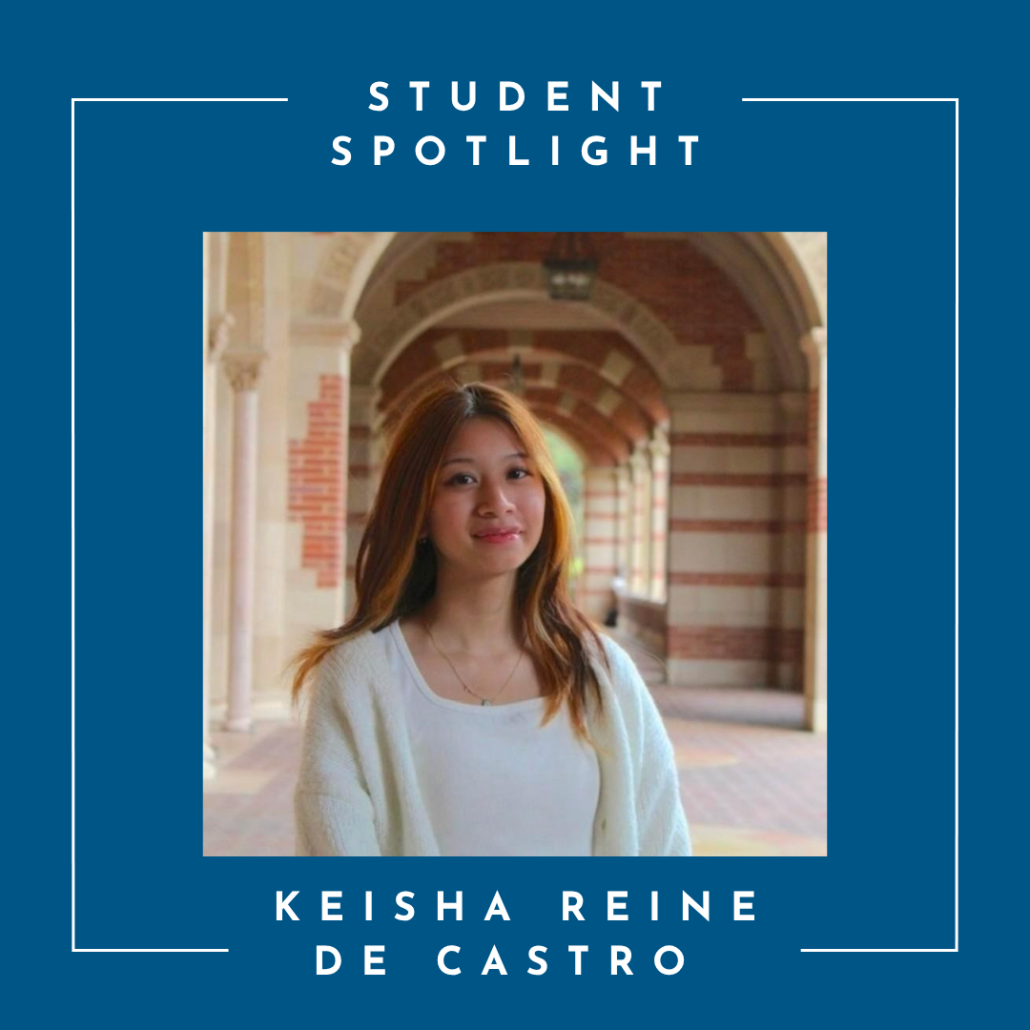
Student Spotlight – Keisha Reine de Castro
Meet UCLA undergraduate researcher Keisha Reine de Castro!
Keisha is double majoring in Disability Studies and Gender Studies with minors in Global Health, Public Affairs, and Community Engagement & Social Change. She is in the Undergraduate Research Scholars Program. Last year, Keisha was in our Undergraduate Research Fellows Program, and her project was “Governing Disability: Access, Corruption, and Disaster Preparedness in the Philippines.”
How did you first get interested in your research project?
I initially became interested in this research through my connection to the Philippines. I moved to Los Angeles from Manila at 9 years old, so I did not have the opportunity to engage with research about the communities, experiences, and issues shaping the country I grew up in. However, I stayed connected to my loved ones and community back home by keeping up with Filipino news. It became a small yet meaningful way for me to remain close to my culture and keep practicing my Tagalog. When a major political scandal in the Philippines brought renewed attention to the mismanagement of public funding intended to protect communities and mitigate the devastating effects of flooding, I reflected more critically on who is being protected when disaster preparedness systems fail. Centering my research on accessibility, I wanted to trace how these systematic failures affect people with disabilities, who face barriers to evacuation, communication, as well as emergency services. Through my project, I have analyzed policy documents, government reports, and advocacy materials and examined disability-inclusive governance. Additionally, I incorporated regional and social well-being indicators to understand the disparities that hinder access to disaster risk-reduction systems.
What has been the most exciting aspect of your research so far?
My faculty mentor, Dr. Ninez Ponce, introduced me to regional indicators and measures of social well-being that I had never worked with in the past. I was interested in how these frameworks could help me examine disability inclusion at a local, community-based level. Learning how to connect these measures with both policy and governance pushed me to approach my project with more intent, especially when highlighting the struggles of people with disabilities in rural provinces who have struggled to organize due to limited disability registries, along with insufficient support from their local governments. It made me reflect on how being recognized within a broader community can determine access to disaster preparedness. The process of intersecting data and policy, along with lived experience, has been one of the most meaningful parts of my research.
What has surprised you about your research or the research process?
During the research process, I initially expected to find extensive information solely on the barriers that people with disabilities face during disasters. However, I was surprised to find research documenting the stories of disabled communities organizing and developing localized strategies to prepare for disasters. It was difficult to find this knowledge within both formal government reports and academic literature, especially from the Philippines, where these narratives are oftentimes obscured. Despite this challenge, it also strengthened my commitment to research that recognizes community knowledge as something valuable in its own right, and does not necessarily only become meaningful once it is interpreted by government institutions.
What is one piece of advice you have for other UCLA students thinking about doing research?
Start with a question that genuinely matters to you! You do not need to already know how to conduct research, understand every methodology, or even have a developed project before getting started. I entered URFP with so many questions and a willingness to learn. My mentors helped me discover methods and approaches that I had never heard of in the past. I also encourage my peers to recognize that their communities and lived experiences can be meaningful starting points for their research. At a large research institution such as UCLA, it can oftentimes feel like knowledge belongs solely to professors and experts with extensive experience. However, I hope that all students can see research as an opportunity to become curious about the issues that disproportionately affect their communities and bring those questions into academic spaces. For me, research thrives when those who are underrepresented become the researchers themselves.
What effect do you hope your research has in your field, at UCLA, in your community, or in the world?
I hope that my research contributes to an inclusive understanding of disaster preparedness and actively challenges the institutional structures that have historically excluded disabled communities from disaster planning. People with disabilities across the world face additional challenges that are deeply tied to evacuation, communication, and timely access to life-saving information. This makes it especially crucial for preparedness systems to account for individual needs. While political corruption and weak governance are weaponized to deepen structural inequities, communities continue to organize and develop their own systems in response to these disasters. I hope my research can help encourage researchers and policymakers to see disaster preparedness as being responsive to how people with disabilities communicate, organize, and care for one another.
You can find Keisha on Instagram at @kluvvu.