

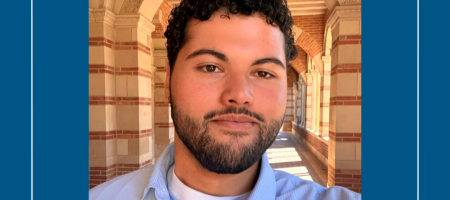
Student Spotlight – Andres Osorio
Meet UCLA undergraduate researcher Andres Osorio!
Andres is majoring in Political Science and is part of the Undergraduate Research Fellows Program. Andres’s project is “Today’s Voter: Examining American Voter Turnout Across Age, Race, and Ethnicity.”
How did you first get interested in your research project?
I first became interested in my research project after founding VoteVotaVote, a nonpartisan, youth-led, 501(c)(3) nonprofit organization with the goal to maximize the impact all people can have within our political system. VoteVotaVote created bilingual (English-Spanish) civic information and voter engagement resources, and shared them via social media, in-person outreach, and partnerships with aims of dismantling barriers to participation. While we were able to civically engage people, the more I got involved, the more I began to see the underlying structure causing low levels of voter turnout for certain ages or racial and ethnic groups. My research project is the next step in my exploration of this phenomenon I witnessed and am fascinated by: differences in voter turnout across age, race, and ethnicity. This project is rooted in my experiences within my own community and observations of other communities of color in which voter turnout gaps persist.
What has been the most exciting aspect of your research so far?
The most exciting aspect of my research has been the privilege it offers me to pursue learning about my interests in an environment designed for that purpose. Being able to research behavior I witnessed in my community and contextualize it with diverse scholarship has been exhilarating. The URC-HASS Undergraduate Research Fellows Program empowered my excitement through fostering a supportive and inclusive research environment allowing my research to thrive.
What has surprised you about your research or the research process?
What has surprised me about the research process was the formulaic nature of political science research. I was also surprised that despite this formulaic nature, there is still no “right way” to conduct research. Initially, I was daunted by how I believed my research had to look. However, as I researched and received advice from my faculty mentor, Dr. Lorrie Frasure, I realized that the research I was conducting serves to provide a new perspective to what is already known. Through this perspective, what had previously intimidated me shifted into an understanding that what I was working on had a deeper meaning, empowering me to research authentically.
What is one piece of advice you have for other UCLA students thinking about doing research?
As a first-year transfer, my one piece of advice for other UCLA students, especially transfers, interested in research is: say “yes” to the resources and opportunities provided to you. When applying for the URFP program, I was in my first quarter at UCLA and felt, as so many others do, like an impostor—that I did not belong or was not qualified enough for the program. However, by taking advantage of resources offered by URC and the Library during the application process, those feelings went away as peers helped change the narrative I was telling myself, while refining my application.
What effect do you hope your research has in your field, at UCLA, in your community, or in the world?
I hope that my research will contribute new knowledge to fill the gaps in understanding regarding voter turnout across age, race, and ethnicity amongst U.S. adults. This research, which stands on the shoulders of many giants, hopes to use new data to examine existing theories of voter turnout to better understand their applicability to an increasingly diversifying American electorate. I hope that this research provides new contexts for organizations to mobilize voters with. But my greatest hope is that this research is used to inform policy which seeks to close age-based and racial or ethnic gaps in voter turnout.