

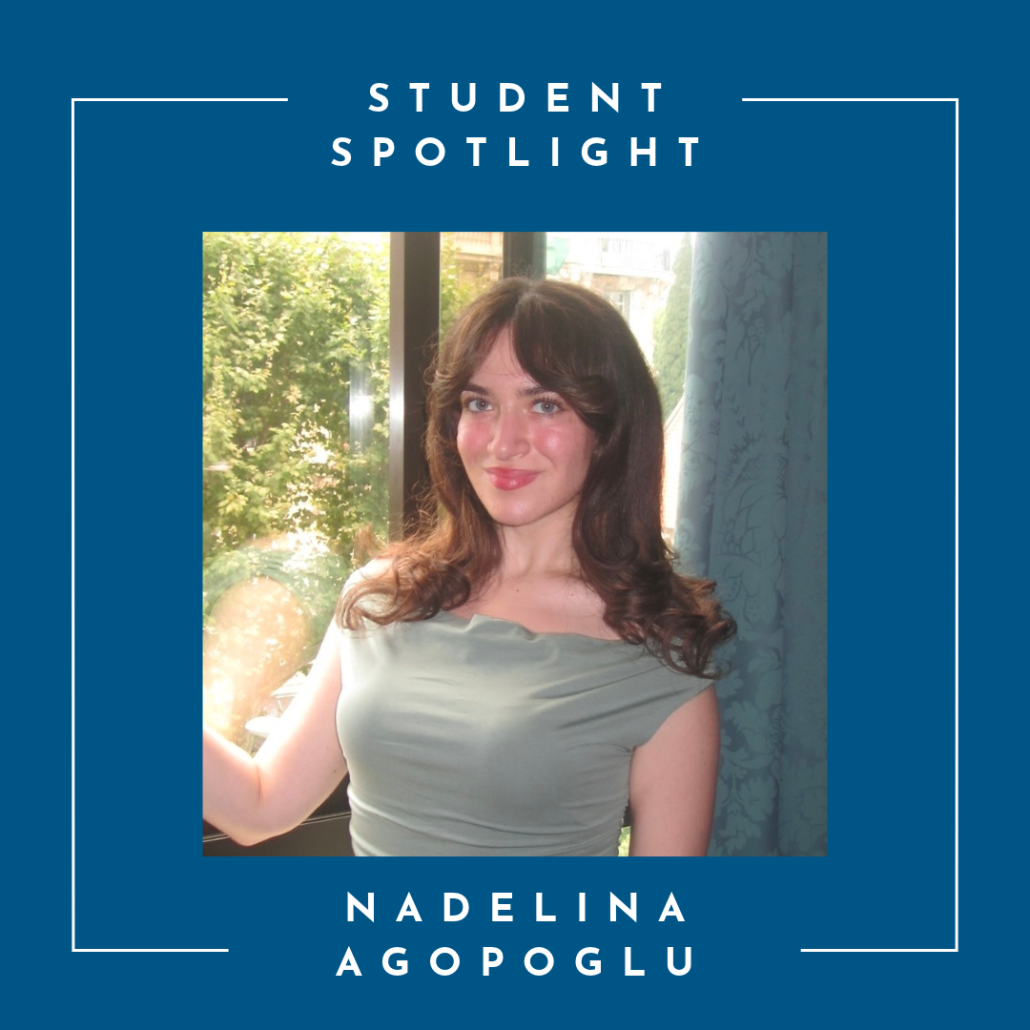
Student Spotlight – Nadelina Agopoglu
Meet UCLA Undergraduate researcher Nadelina Agopoglu
Nadelina is majoring in English and Gender Studies. She was in our recent Summer Fellows Program cohort and conducted research examining the intersection of literature and video games. Nadelina’s summer project was “Danganronpa V3: Killing Harmony and Postmodernism.”
How did you first get interested in your research project?
While I had been a fan of the Danganronpa video game series for a long time, I had never considered how video games could serve as an object of research until I took the class “Interdisciplinary Studies of American Culture: Repression and Freedom in Late 20th-Century America” with Professor Rafael Perez-Torres in my first quarter at UCLA. The course introduced me to many new ideas and revealed to me new ways in which I could understand literature. Professor Perez-Torres articulated and explained postmodernism (which I had formerly seen as a daunting concept) in such an accessible manner that I was able to find a connection between the concept of postmodernism and Danganronpa V3: Killing Harmony, a visual novel game I first encountered in middle school and had loved since. In the course, we talked about postmodernism as a denial of a single truth or a lack of truth, and this idea instantly stood out to me as a point of possible connection between postmodernism and DRV3. I asked Professor Perez-Torres if he had any sources that had expanded on this idea, and with his recommendations, I started to find research pathways I could take to undertake a project with one of my favorite pieces of media as an object of analysis.
What has been the most exciting aspect of your research so far?
The most exciting aspect of my project has been being able to conduct research on a piece of media that has been so close to my heart for many years and gaining a new perspective on it through the ideas I had ingested from my coursework. It has been so thrilling to consider different aspects of the game, trying to connect it to theory in ways I would not ever have thought about otherwise. It was so thrilling to see that at no point in the research process had I reached a “dead end;” in fact, it felt like I couldn’t stop finding new nexuses. Finding the “perfect” quote for a point I had wanted to make in my research project felt like correctly piecing together the pieces of a puzzle, and understanding the game through research felt incredibly satisfying.
What has surprised you about your research or the research process?
What surprised me about the research process is how new thoughts and ideas emerged as I was drafting my research. The product of my research deviated significantly from what I had expected, and I find that allowing for these deviations is what makes the research process so enriching. For instance, when I first started collecting materials for analysis, I had an impression of what I would use and what I would focus on, but it was not until I started writing that I realized how much my research would stray from my initial expectations. My project ended up outgrowing this mold I had created for it. Letting my research take the shape it was growing into was a revelatory and exciting experience.
What is one piece of advice you have for other UCLA students thinking about doing research?
One piece of advice I have for other UCLA students who are thinking about doing research is to simply start it and see where it goes. I often feel like an idea is too out of reach or hard to execute, but once I start writing, I find that I am able to find my flow!
What effect do you hope your research has in your field, at UCLA, in your community, or in the world?
What I hope my research will do is encourage others to focus on electronic literature as an object of analysis. Visual novels, which are a type of video game, are not always considered objects of literary analysis in the academic space. I believe that placing them at the forefront of academic discussion can be valuable when we consider how literary form responds to the cultural circumstances of our current moment.
You can follow Nadelina on Instagram at nadelina_a.