

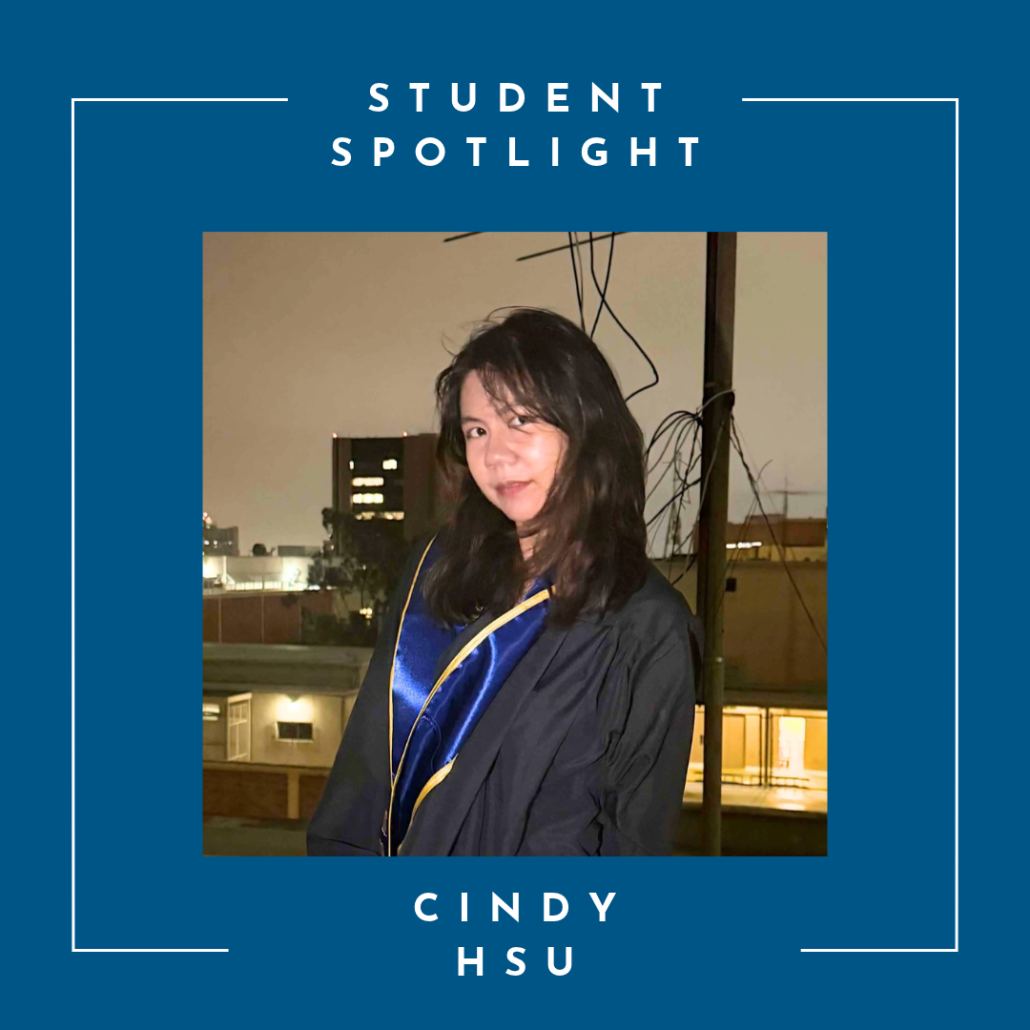
Student Spotlight – Cindy Hsu
Meet UCLA Undergraduate researcher Cindy Hsu
Cindy is majoring in Design Media Arts and Gender Studies. She was in our recent Summer Fellows Program cohort where she produced a research projected entitled “Erotic Arts as Tools for Transcendence and Trauma Reconciliation: Lana Del Rey and Her Music.”
How did you first get interested in your research project?
After I completed my first Gender Studies undergraduate research experience at UCLA under Dr. Michael Hunter, I was contemplating researching how sexuality, erotic fetishism, and sexual experiences influence people’s political alignment. Over the years, this curiosity evolved while I grew as an artist. When I began my Desma (Design Media Arts) Senior Capstone project, I explored and challenged my own trauma through visual arts and performance. Experimental art-making requires courage and a willingness to embrace uncertainty. Through this process, I became fascinated by how our ego and subconscious imaginations interact, and what broader psycho-social observations we could derive from individual experiences. On the other hand, Psycho-sociology books such as Nancy Chodorow’s The Reproduction of Mothering were eye-opening and inspiring. Aiming to understand what draws people to violence and generational trauma, I was determined to unpack psychoanalysis’ potential in cutting through the division between gender constructivism and essentialism, as well as offering new solutions to end the cycle of violence.
What has been the most exciting aspect of your research so far?
Reading a book is comparable to going on a journey, and I found myself connecting dots I never expected to, which was truly satisfying. This is especially true because my research deals with some of the most intimate and striking subjects of human relations and subjectivity. From Freud’s Beyond the Pleasure Principle, the foundational text that pioneered discussion in the human phenomenon of repeating traumatic cycles, to Saketopolou’s Sexuality Beyond Consent, a book that critiques therapists’ false fixation on curing trauma when it can never be fully dissolved, it was a delight to see how studies of trauma unfold over the decade. Each step in this journey helped me see how psychology, sociology, philosophy, science, and art intersect. That web of knowledge and epistemology is the most beautiful, transformative experience for any curious person. At the end, I learned not only about Psychoanalysis, BDSM case studies, theaters, and the subconscious forces, but also about myself. This research made me feel vindicated as an artist.
What has surprised you about your research or the research process?
What surprised me was how my object of analysis shifted over time. My first research proposal started with studying fetishized violence in American soldiers through using psychoanalysis and the “other” as a site of subversion. I wanted to understand how violence is stored in the body. However, each new reading shifted the research direction until Dr. Hunter pointed out how art had been central to all our discussions. As a fan of Lana Del Rey, listening to her music and discussing her with Dr. Hunter made me realize that she was the perfect subject. Eventually, my research focused on art’s potential as a therapeutic tool to help people deal with trauma by bringing the inaccessible, subconscious parts of people’s egos into the light. If people have a compulsion to repeat trauma or find pleasure in art and media that reflect those traumas, Lana Del Rey’s controversial music videos and songs brought the feminist question into this inquiry. Some feminists have criticized Lana Del Rey for provocative depictions of age-gap relationships and playing into the male gaze. However, she is also seen as an icon in the queer communities, and her work resonates with many women. Ironically, her outstanding talent as a lyricist and songwriter was overshadowed by mainstream pop artists and her own criticisms. Therefore, I decided to explore her autonomy and the subversiveness of her art more deeply.
What is one piece of advice you have for other UCLA students thinking about doing research?
Never be afraid of uncertainty and being creative. Flexibility matters, and anything can influence your research process. Research can be messy, but what truly matters most is how you make connections and organize information. As an artist, I have always explored my own trauma through an introspective, creative lens. The novels I read fit into my research surprisingly well, and discussing it with my mentor helped narrow my research scope.
What effect do you hope your research has in your field, at UCLA, in your community, or in the world?
I hope my research reveals the nuances of human psychology that connect people by highlighting how people’s actions can contradict their beliefs. Through revealing the convoluted layers of the human psyche from the perspective of gender, erotica, desire, and trauma, I want to offer a new framework of feminist thinking that critiques beyond the surface-level cancel culture. That is not to undermine the importance of media literacy and challenging patriarchal norms, but to sharpen and broaden feminist philosophies’ inclusivity, humanity, and depth. This could empower those who feel marginalized because their desires don’t fit the feminist status quo and leverage a more sustainable way of approaching and deconstructing provocative gendered depictions of violence in media.
You can follow Cindy on Instagram at z_cin1006.